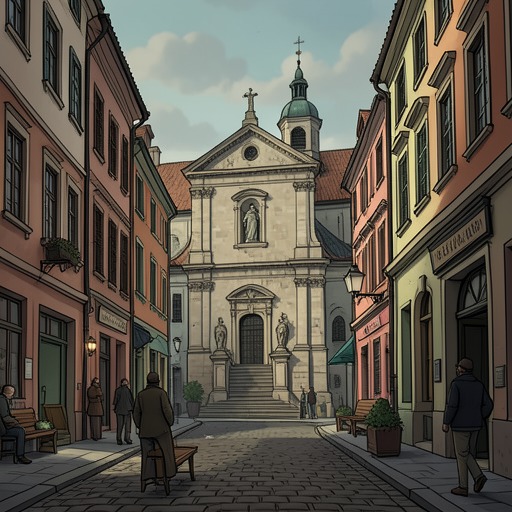
Seville Cathedral
La piel del tamborSeville Cathedral is the monumental landmark that gives the surrounding cityscape its defining shape and historical depth. For Lorenzo Quart, arriving in Seville on a discreet assignment, the Cathedral and its Giralda are more than a backdrop: they embody the accumulated histories of the city, while their enduring presence throws the threatened Nuestra Señora de las Lágrimas into sharper relief.
Setting and historical layers
From Plaza Virgen de los Reyes, the Cathedral’s tower rises beside the Archbishop’s Palace and the former walls of a mosque. The Giralda itself is the transformed minaret of that earlier building, a visible reminder that Seville’s religious and architectural histories overlap rather than replace one another. Quart reads the square as a conjunction of cultures and centuries: the old Jewish quarter lies behind him, a convent stands nearby, and the Cathedral completes a landscape shaped by successive faiths and histories.
The Cathedral’s setting also makes the difference between inherited stone and modern tourism palpable. Postcard sellers, horse-drawn carriages, visitors queuing for the tower, and cameras occupy the same square as buildings that have survived for centuries. Quart imagines the stones as capable of speaking if one can set aside the tourist spectacle and listen. The place’s significance rests in this layered continuity, not in any single monument viewed in isolation.
The Cathedral at night
Later, beneath the Cathedral’s floodlit silhouette, the contrast between illumination and darkness turns the square into an almost theatrical scene. Pigeons scatter through the night, appearing and vanishing among the domes, pinnacles, and flying buttresses, while the Giralda rises above them. Quart thinks the setting resembles an elaborate painted film backdrop, but the comparison only underscores its irreproducibility: the square is authentic, built from brick and centuries, and no studio could recreate it.
Macarena Bruner walks a few steps beneath the square’s great central lamp and stops against the golden stone and the lights. Her presence intensifies Quart’s awareness of the place’s beauty, and the stillness between them gives the Cathedral square an intimate charge. Yet the moment also unsettles the disciplined detachment expected of a priest: the monumental setting frames an attraction that does not sit comfortably with Quart’s professional and religious obligations.
A landmark beside a threatened church
The Cathedral’s prominence contrasts with the precarious condition of Nuestra Señora de las Lágrimas, the parish church Quart has been sent to investigate. The proposed demolition depends on secularizing that building, but an old privilege protects it so long as Mass is celebrated there each Thursday for Gaspar Bruner de Lebrija. The Archbishop explains that the privilege was granted in 1687; Macarena later specifies that the Mass must be held at eight in the morning, on the weekday of her ancestor’s death in 1709. A diocesan representative and a notary paid by Pencho Gavira watch for any lapse that might remove the church’s protection.
The two churches therefore occupy different positions in the same religious landscape. The Cathedral stands as an established monument, its successive architectural layers legible in the city’s skyline. Nuestra Señora de las Lágrimas, by contrast, must rely on a precise recurring rite and a historical condition to resist demolition. Its survival is not secured simply by its sacred purpose: it depends on discipline, procedure, and the persistence of those who defend it.
Narrative significance
The Cathedral gives Quart’s Seville a scale of time against which present conflicts can be measured. Its minaret-turned-bell tower and centuries-old square make the city a visible archive, while the church dispute shows how easily a much smaller sacred place can be exposed to institutional and commercial pressure. The contrast connects architecture to memory: the city’s history endures in stone, but the survival of a particular church still hangs on human action and a Thursday Mass.
In this way, the Cathedral is both setting and interpretive counterweight. Its nocturnal grandeur draws Quart and Macarena into a moment of heightened intimacy; its historical layering helps define the city he is learning to read; and its permanence makes the threatened parish’s vulnerability impossible to mistake.